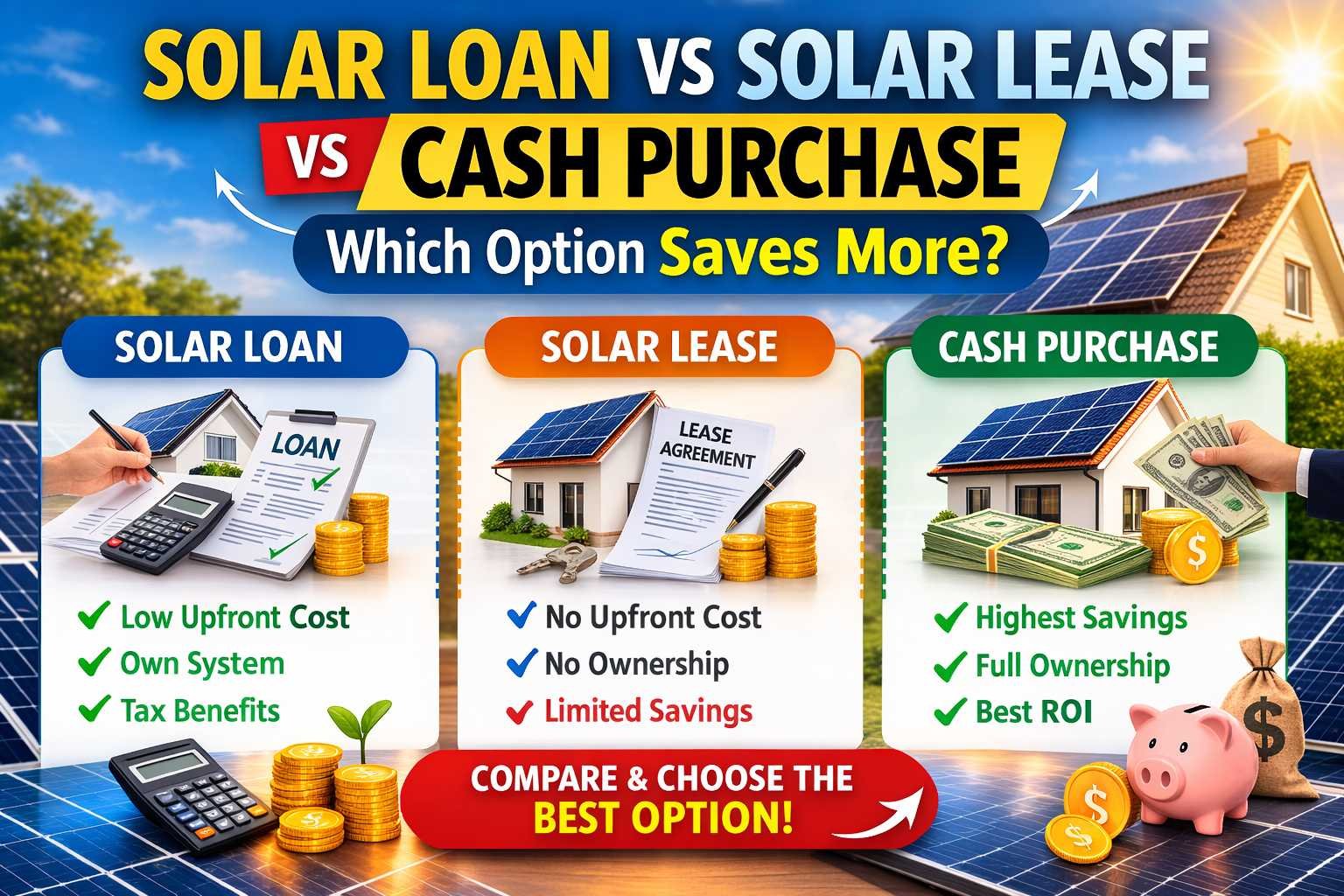
Switching to solar energy is one of the best long-term investments for homeowners in the United States. However, installing a solar system can cost around $25,000–$30,000 on average before incentives, depending on system size and location.
Because of this high upfront cost, homeowners usually choose one of three payment options:
- Cash Purchase
- Solar Loan
- Solar Lease
Each option has different costs, savings potential, and long-term benefits. In this guide, we’ll compare these three solar financing methods to determine which option saves the most money over time.
Understanding the Three Solar Payment Options
Before comparing savings, it’s important to understand how each option works.
Cash Purchase
A cash purchase means paying the entire cost of the solar system upfront. Once installed, you fully own the solar panels and receive all the benefits, including incentives and energy savings.
This option offers the highest lifetime savings because there are no interest payments or monthly financing fees.
Solar Loan
A solar loan allows homeowners to install solar panels with little or no upfront cost. Instead of paying everything upfront, you repay the system cost through monthly loan payments.
Solar loans typically have interest rates around 6%–9% in 2026, depending on credit score and loan terms.
With a loan, you still own the solar system, which means you can qualify for tax credits and incentives.
Solar Lease
A solar lease is a long-term agreement where a company installs solar panels on your roof, but the company owns the system. You pay a fixed monthly fee to use the solar energy produced.
Most solar leases have contract terms of up to 20–25 years, with little or no upfront cost.
While leasing makes solar more accessible, it usually delivers lower long-term savings compared to owning the system.
Solar Loan vs Solar Lease vs Cash Purchase (Quick Comparison)
| Feature | Cash Purchase | Solar Loan | Solar Lease |
|---|---|---|---|
| Upfront Cost | High | Low / $0 down | $0 down |
| Ownership | You own system | You own system | Solar company owns system |
| Tax Credits | Yes | Yes | No |
| Monthly Payments | None | Yes | Yes |
| Lifetime Savings | Highest | Medium-High | Lowest |
| Maintenance Responsibility | Homeowner | Homeowner | Solar company |
Which Solar Option Saves the Most Money?
1. Cash Purchase – Highest Long-Term Savings
Buying solar panels with cash typically produces the largest return on investment.
Benefits include:
- No interest payments
- Full access to federal and state incentives
- Maximum electricity bill savings
- Increased home value
Solar systems usually last 25 years or more, allowing homeowners to generate free electricity long after the system has paid for itself.
For homeowners who can afford the upfront cost, a cash purchase almost always delivers the highest lifetime savings.
2. Solar Loan – Best Balance Between Cost and Savings
A solar loan is the most popular option for homeowners who want to own their system but cannot pay upfront.
Advantages include:
- Little or no upfront cost
- Ownership of the system
- Eligibility for tax credits
- Strong long-term savings
However, because loans include interest payments, total savings are usually slightly lower than cash purchases.
Still, solar loans often provide significantly better long-term savings than leasing.
3. Solar Lease – Lowest Long-Term Savings
Solar leasing allows homeowners to install solar panels without paying upfront. The solar company covers installation costs and maintenance.
Advantages include:
- No upfront investment
- Maintenance handled by provider
- Immediate electricity bill reduction
However, leasing has several disadvantages:
- You do not own the solar panels
- You cannot claim tax credits
- Long-term savings are smaller
Because the leasing company owns the system and collects incentives, homeowners typically receive much lower lifetime savings than with ownership options.
Example Savings Comparison
Let’s look at a simplified example for a $30,000 solar system over 25 years.
| Payment Option | Total Savings Over 25 Years |
|---|---|
| Cash Purchase | $40,000 – $60,000 |
| Solar Loan | $25,000 – $45,000 |
| Solar Lease | $10,000 – $20,000 |
Actual savings depend on electricity prices, incentives, and system performance.
Factors That Affect Solar Savings
Several factors determine how much money a homeowner saves with solar.
Electricity Prices
States with high electricity costs usually see faster solar payback periods.
Solar Incentives
Programs like the Federal Solar Investment Tax Credit (ITC) allow homeowners to claim a tax credit on solar installation costs.
Loan Interest Rates
Higher loan interest rates reduce total savings.
Homeownership Duration
Solar systems typically reach their payback period within 7–12 years, depending on location.
Homeowners who stay longer in their home generally see larger savings.
When Each Option Makes Sense
Cash Purchase is Best If:
- You have available savings
- You want the highest ROI
- You plan to stay in your home long term
Solar Loan is Best If:
- You want to own the system
- You prefer affordable monthly payments
- You still want tax incentives
Solar Lease is Best If:
- You cannot afford upfront costs
- You want simple installation
- You prefer maintenance handled by the provider
Final Verdict: Which Option Saves More?
In most cases, the ranking for solar savings looks like this:
- Cash Purchase – Maximum lifetime savings
- Solar Loan – Strong savings with flexible payments
- Solar Lease – Lowest savings but easiest entry
While leasing may reduce upfront costs, homeowners who own their solar system typically save far more money over the system’s lifetime.
For many U.S. homeowners, a solar loan provides the best balance between affordability and long-term savings.
Frequently Asked Questions
Is it better to buy or lease solar panels?
Buying solar panels usually delivers the highest lifetime savings because you own the system and receive all incentives.
Can I get solar panels with no money down?
Yes. Many solar loan programs and leases offer zero-down installation options.
How long does it take solar panels to pay for themselves?
The average solar payback period in the United States is about 7–12 years, depending on electricity prices and incentives.
Do leased solar panels increase home value?
Typically no. Because the homeowner does not own the system, solar leases may complicate home sales.